
Tioga County Projected Versus Actual Release
A projected or scheduled release date is a current estimate based on the records and rules then in effect. An actual release date records a custody event that already happened. Pennsylvania adds other milestones: the judicial minimum is generally the first point when ordinary parole may be considered, the Board’s grant approves parole subject to execution, physical release changes custody, and maximum expiration or lawful discharge ends legal custody.
Those milestones should not be collapsed into one date. A parole grant can await an approved release plan, detainer resolution, or administrative work. A person released on parole remains under legal custody until the maximum or discharge. Someone moved from Tioga County Prison to PADOC, another county, federal custody, or immigration custody has transferred, not entered the community.
Scheduled versus actual: A scheduled date is subject to change. Confirm release only through the responsible records office and the recorded release or transfer event.
A pretrial detainee usually has no sentence-based projected release date. Bail may be posted, conditions may change, charges may be dismissed, or a judge may enter a new order. The UJS docket can show the legal action, but Tioga County Prison must finish processing before physical release occurs.
PADOC Tioga County Release Date Fields
The current PADOC Inmate/Parolee Locator does not expose an inmate field labeled “Projected Release Date” or “Tentative Release Date.” Do not relabel another field to fill that gap. Its Department Supervised Individual side does provide Release Date, which is an actual past release into PADOC supervision. It may also display the district office and supervision identifiers.
The locator covers people in Pennsylvania state custody or supervision. It is not a Tioga County Prison booking archive. A person serving only a county term may never appear. The official search screen below shows the PADOC entry point, which is useful for identifying state custody but cannot supply a public projected field that the interface does not contain.
Open the Pennsylvania Inmate/Parolee Locator before reviewing the captured interface.
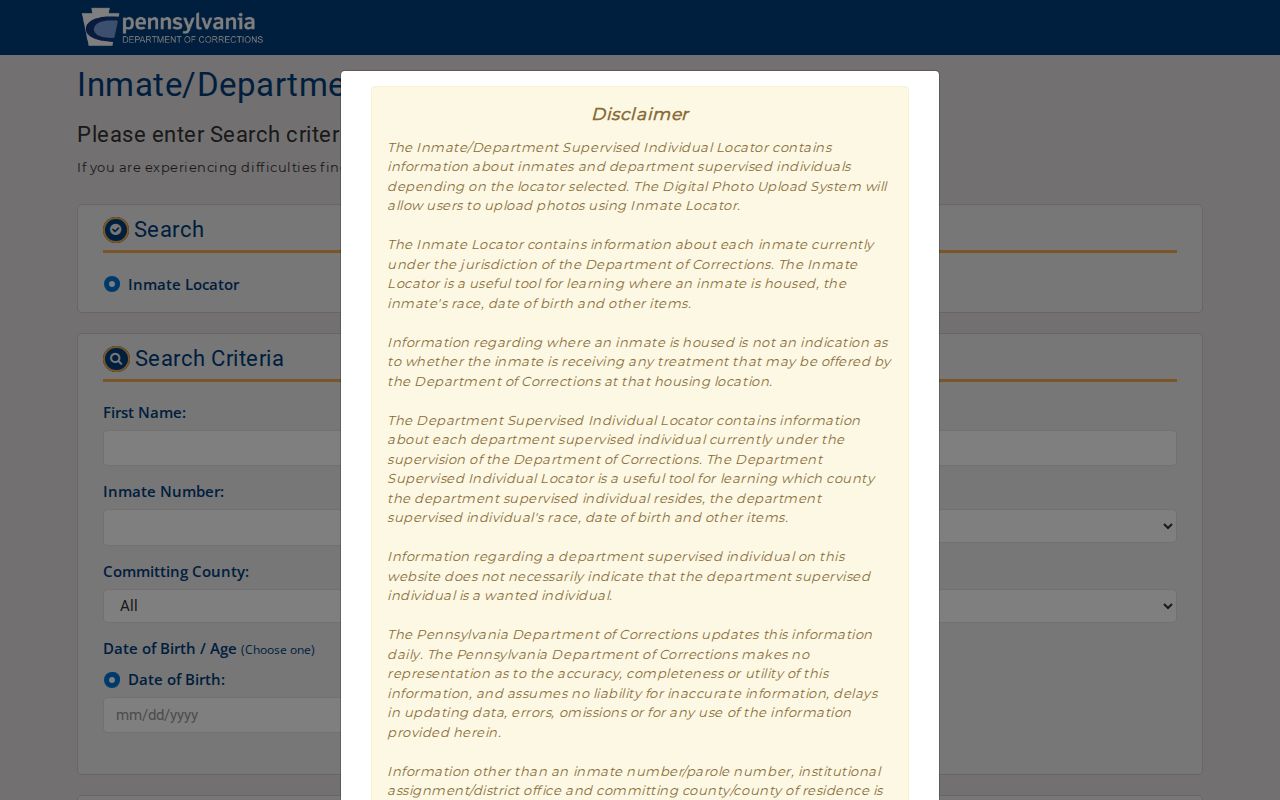
The image confirms the state search route. An exact current sentence computation must come from the sentencing docket and the responsible facility Records Office.
| Displayed or requested item | Correct meaning |
|---|---|
| PADOC inmate result | Current state custody information, not a county booking record. |
| Supervised-person Release Date | An actual past release into state supervision, not a projection. |
| Judicial minimum | The ordinary parole eligibility boundary, not a promised release. |
| Maximum date | The sentence endpoint subject to the valid computation and later orders. |
| Board grant or effective date | Approval that may still depend on release-plan and execution steps. |
Find Tioga County Inmate Release Dates
Classify custody before searching. County cases begin with the UJS docket and Tioga County Prison Administration & Records. State sentences require the docket, PADOC, and the institution’s Records Office. A federal BOP result may display a future Release Date that BOP treats as projected, but that federal label must not be merged with Pennsylvania’s state system.
- Search the UJS case portal by case number or participant, filter to Tioga County, and open the full chronological docket.
- Identify whether the person is pretrial, serving a county sentence, committed to state custody, or held for another authority.
- Read the sentencing order for the minimum, maximum, consecutive or concurrent terms, and credit entries. Check later amended orders.
- For a county term, call Tioga County Prison at (570) 724-5911, option 8, and ask for the current computation or release-record channel.
- For a state term, use PADOC to find the institution, then direct sentence-status questions to that facility’s Records Office.
- After the event, confirm the actual release or transfer record. Do not substitute arithmetic for agency confirmation.
The Tioga County released inmate search provides the wider records path when custody type remains uncertain. A court order explains legal authority, while the prison or agency record proves the physical event.
Note: A bail entry or parole grant may explain an expected release, but processing must finish before the person physically leaves custody.
Tioga County Sentence Date Framework
Under 42 Pa.C.S. § 9756, Pennsylvania generally uses an indeterminate sentence with a maximum and a minimum no greater than one-half of that maximum. The minimum is an eligibility point. It does not compel the Pennsylvania Parole Board to release the person. Ordinary Board parole power under 61 Pa.C.S. § 6137 generally cannot be used before that minimum, and life or death sentences fall outside ordinary Board parole power.
PADOC calculates state minimum and maximum dates from the judgment and valid credit. The Pennsylvania parole process makes clear that the minimum is not a guaranteed exit date. Board review, statutory eligibility, an approved plan, detainers, and execution steps may still affect what happens next.
- Minimum date
- The usual first point for parole consideration, not a release promise.
- Maximum date
- The computed endpoint of the sentence unless a valid legal change applies.
- Detainer
- A request or legal hold that can keep or transfer a person for another authority.
- Sentence credit
- Custody time that the lawful computation applies toward the term.
- Discharge
- The end of legal custody or supervision, distinct from release on parole.
Credit for time served under 42 Pa.C.S. § 9760 can change the remaining term. The docket and Records Office calculation must agree on the orders and credit used. If they do not, the affected person should use the facility’s sentence-status correction route and provide the sentencing and credit documents.
Tioga County RRRI Release Calculation
Pennsylvania has no universal rule that a prisoner must serve 85 percent of the maximum before parole. That claim is wrong for ordinary Pennsylvania parole. The Recidivism Risk Reduction Incentive, or RRRI, is a specific earlier-eligibility mechanism for a person whom the court finds eligible. It is not blanket “good time,” and it does not guarantee release.
Under 61 Pa.C.S. § 4505, an eligible RRRI minimum is three-fourths of an imposed minimum of three years or less. When the imposed minimum exceeds three years, the statutory fraction is five-sixths, subject to aggregation and rounding rules. Five-sixths is about 83.33 percent of the minimum, not 85 percent of the maximum. Three-fourths is 75 percent of the minimum.
Eligibility exclusions in § 4503 and the court finding under § 9756(b.1) are essential. Never infer RRRI eligibility from sentence length. Short Sentence Parole and reentry supervision are other statutory paths for qualifying cases, with their own current exclusions and procedures. Because those provisions can change, the live statute and individual record control.
A county-jail sentence cannot be projected by applying a PADOC formula. The Tioga sentencing order, credit, jail computation, bail or detainers, and other valid provisions determine the event. Work release is also not discharge. Tioga County lists a Work Release Program, but a participant may remain legally confined during authorized time outside.
Why Tioga County Release Dates Change
A computed release date can move because the underlying legal or administrative facts move. Some changes alter the mathematical sentence computation. Others do not change the sentence but delay physical release or change the receiving authority. The responsible Records Office must separate those effects.
| Factor | Possible effect |
|---|---|
| Credit for prior custody | Valid credit can reduce the time remaining under the sentence calculation. |
| Consecutive or concurrent terms | The way terms combine changes minimum and maximum computations. |
| Amended or appellate order | A later valid court order may revise the controlling sentence. |
| Detainer or hold | The person may transfer to another authority instead of entering the community. |
| Parole decision | A grant, denial, rescission, or later action affects eligibility and execution. |
| Release plan approval | An effective parole date may be postponed until a satisfactory plan is approved. |
| Program or disciplinary event | A consequence under applicable law may affect an available statutory path. |
Data corrections can also change what appears. Pennsylvania parole regulations state that a grant notice may carry an effective date while release waits for a satisfactory plan. They also provide that parolees remain in legal custody until maximum expiration or lawful discharge. The date of leaving prison is therefore not always the end of the sentence.
Note: A change in destination can matter as much as a date change because transfer and community release are different custody outcomes.
Tioga County Prison Date Checks
For a sentence served at Tioga County Prison, obtain the sentencing order, commitment, and credit entries first. Then ask Administration & Records for the current release-computation channel and, after departure, the effective release or transfer record. The prison is at 1768 Shumway Hill Road, Wellsboro, PA 16901, and its published line is (570) 724-5911 with option 8 for Administration & Records.
No Tioga County policy establishing a weekend-adjusted release rule was found. Do not promise an earlier or later date based on a weekend or holiday assumption. The research also found no universal county bond schedule. For a pretrial person, read the case-specific bail order and ask the prison whether release processing is complete.
Tioga rents some beds to other authorities. That local fact can change the meaning of departure. Someone physically held at Tioga County Prison may remain the responsibility of Potter, Union, or another authority and may return there. Ask for the committing authority, release or transfer authority, and destination rather than merely asking whether the person left the building.
When a date appears wrong, the affected person should present the judgment, commitment, and credit documents through the proper Records Office correction route. A public estimate cannot resolve a sentence-credit dispute.
Confirm Tioga County Actual Release
Never use an arithmetic estimate as release confirmation. For a county sentence, the Tioga County Prison release or transfer record controls the physical event. For a state sentence, use the current PADOC calculation and institution record. The supervised-person Release Date can corroborate actual parole release after it occurs, while the Board Action establishes the parole decision.
PA SAVIN through VINELink may send an alert for a reported release, transfer, escape, or recapture. The Tioga County VINELink Release Check explains how to register and interpret that event. An alert is not a certified record and should not control a court deadline, travel plan, or claim of unconditional freedom.
Ask a precise final question: “Was the person released to the community or transferred, and what effective date and authority appear in the record?” That wording prevents a departure from being mistaken for freedom. It also directs staff to an existing field instead of asking them to create a prediction.
Verification rule: The responsible records office’s current computation plus the actual release or transfer event controls. No calculator can replace both records.